Hello, everyone! I’ve got a good bit of catching up to do, and the present is the perfect time and place to do it! Get ready for a lot of posts…
After our Seattle adventure at the end of May, Shelby and I parted ways. She headed up to Ketchikan, AK, a few days ahead of me, and I drove up to Anacortes, WA. My final destination was Friday Harbor on San Juan Island. I had heard wonderful things about the region from friends and family who had traveled there and I was interested in checking out the Friday Harbor Laboratories (FHL), part of the University of Washington.
I drove onto the state ferry bright and early at 5:30 AM, and cruised through the calm waters surrounding the relatively undeveloped San Juan Islands. When the ferry arrived at Friday Harbor, a lovely ocean town beckoned through the window. I wish I had a good picture of the town from the water, but I just couldn’t do it justice.
I drove off the ferry and straight down to FHL where I was greeted by the Diving Safety Officer, Pema Kitaeff. Pema welcomed me to the island, handed me a pair or rubber boots, and we hurried on down to the dock to board the Centennial. This fishing ship-turned-research vessel is utilized for a menagerie of marine research and outreach programs by the university.
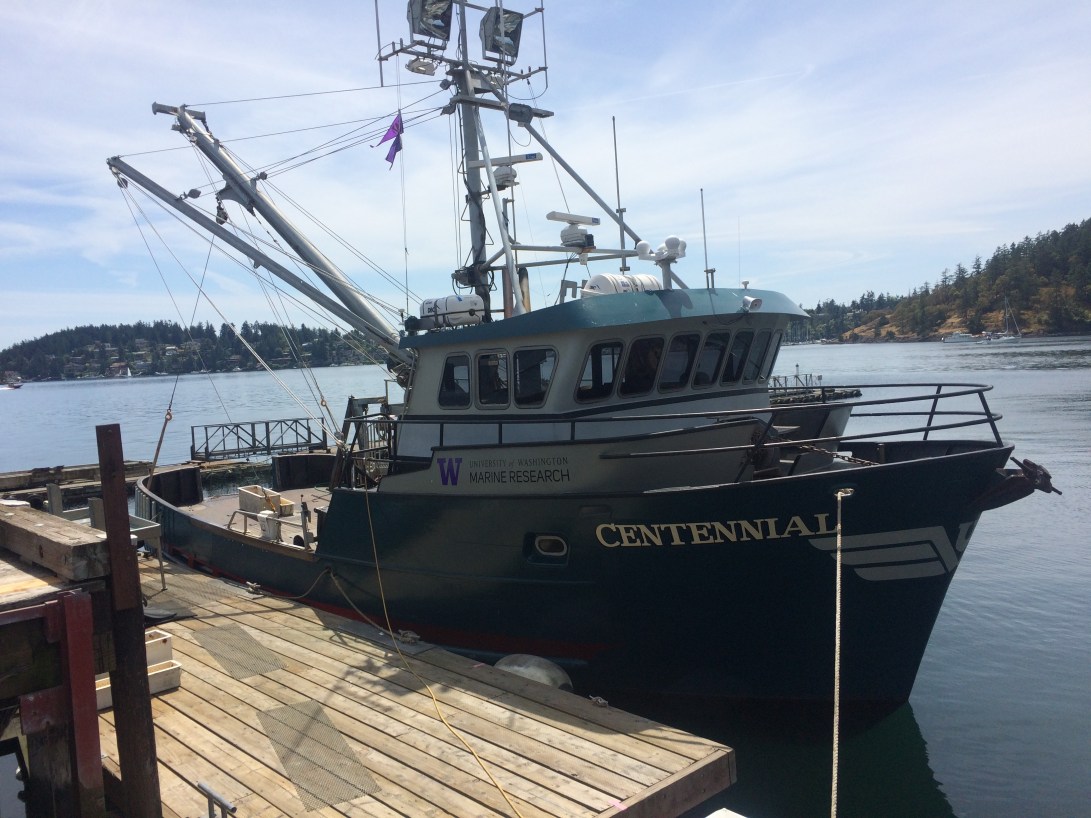
The R/V Centennial docked at FHL.
Pema had invited me to join her and a couple volunteer scuba divers on the Centennial for a few outreach trips for local elementary students. Though these students are raised on the surrounding islands and enjoy boat and kayak access, getting into much less below the local waters is a much bigger deal. The waters here range in the 40’s-50’s F throughout the year – a bit too chilly to spend much time in without specialized gear. Pema and her volunteers were here to introduce these students to the vivacious underwater world of the Pacific Northwest.
We stopped by the Friday Harbor Marina to load up the students, teachers, and chaperones, and then we were off! On the short ride over to the dive site, the two volunteer divers, Rhoda and Jess, told the eager group about the scuba dive they were about to embark on. They would both be using standard scuba gear, with a couple specialized pieces of equipment you wouldn’t typically find on a standard recreational dive:
- Dry suit: Unlike a wetsuit, which uses a thin layer of water to insulate body heat, a dry suit seals at wrists and neck and keeps the wearer completely dry except for their head. However, being dry isn’t enough to stay warm in these cold waters – the wearer must either wear thermal undergarments underneath the dry suit, or have the suit made out of a thick insulating material (such as neoprene) in order to stay warm.
- Full face mask: A bit different than a typical mask (which only covers the eyes and nose), a full face mask also covers the mouth and contains the scuba regulator (which provides air from the tank). These divers had specialized face masks that were equipped with communication devices (or “comms” in dive slang) including a speaker and microphone so the divers could converse with everyone on the ship in real time.
- Tethered video camera: Used to transmit a live feed of video from the divers up to the ship. Students were able to view what the divers were seeing in real time, accompanied by live audio.
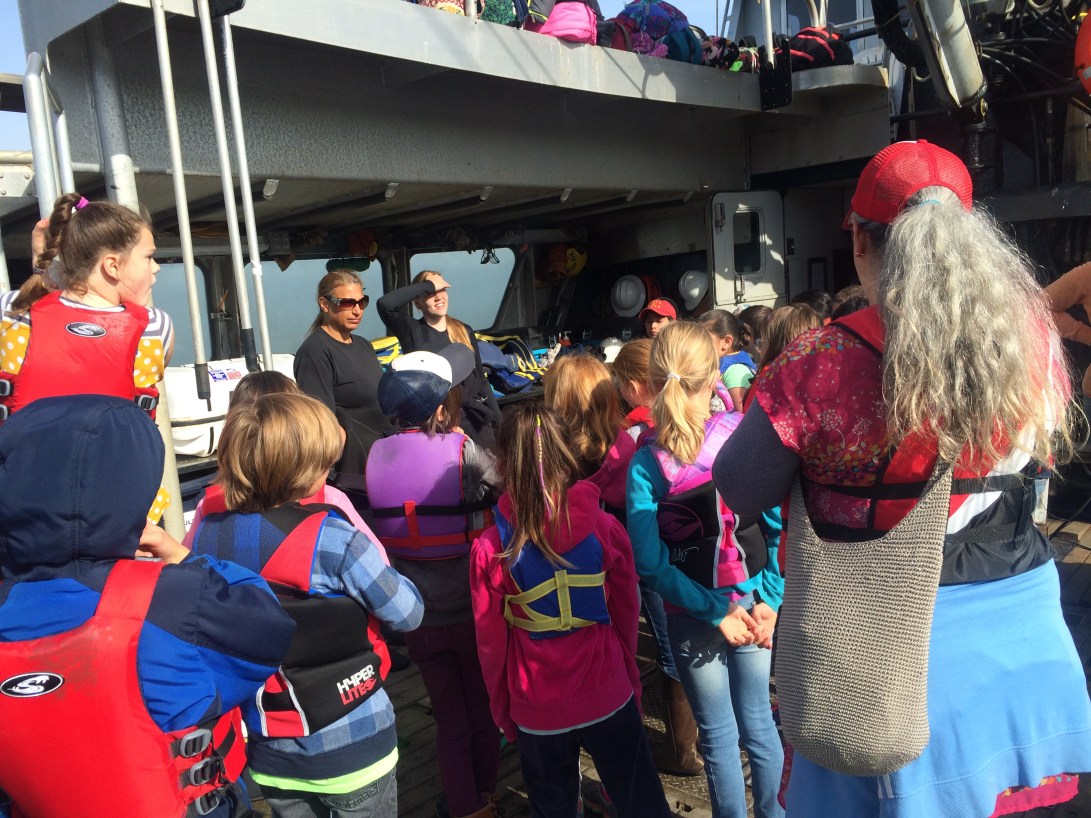
Volunteer divers Rhoda and Jess talk about their equipment to the eager students.
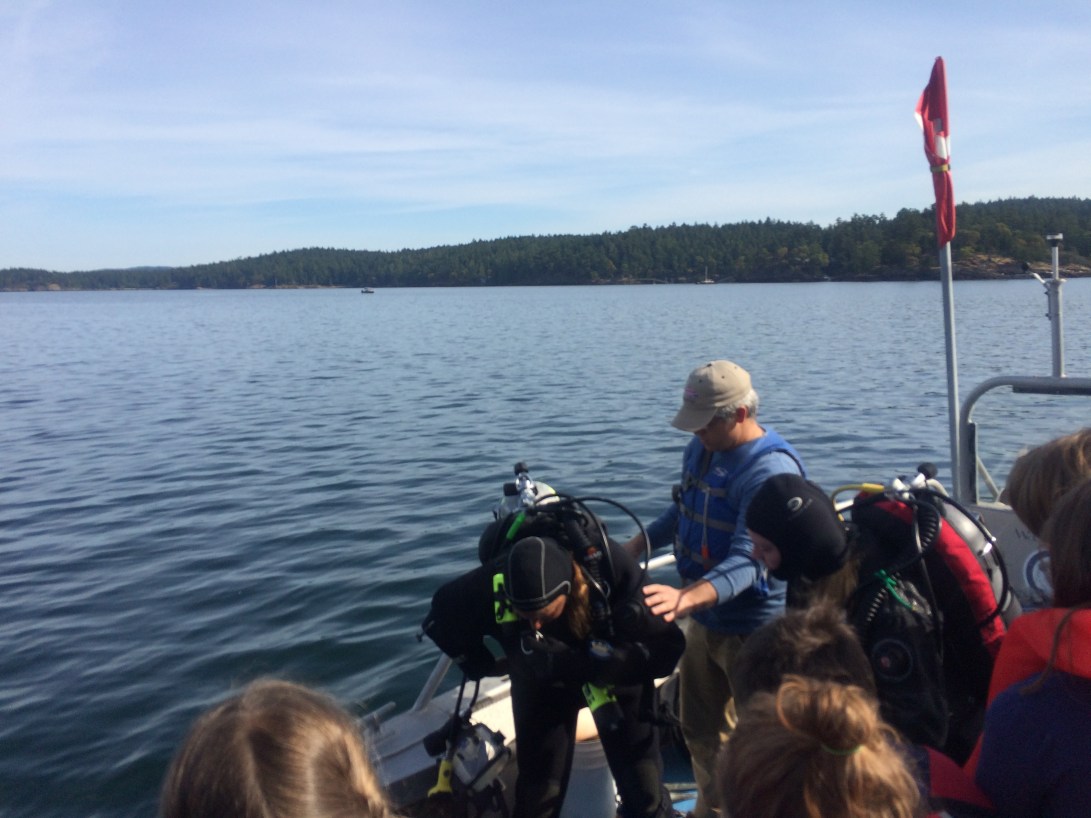
Getting prepped for hopping in the cold water!
During the dive, Rhoda and Jess collected several species from the ocean floor and brought them up to the ship for the students to experience hands on! Here you can see a sea cucumber (the lumpy one being petted), a kelp crab to its right, some sea slugs scattered throughout the bin, what appears to be a mottled star (hard to ID from the picture), and the bright orange arms of a vermilion star are peaking out near the bottom.
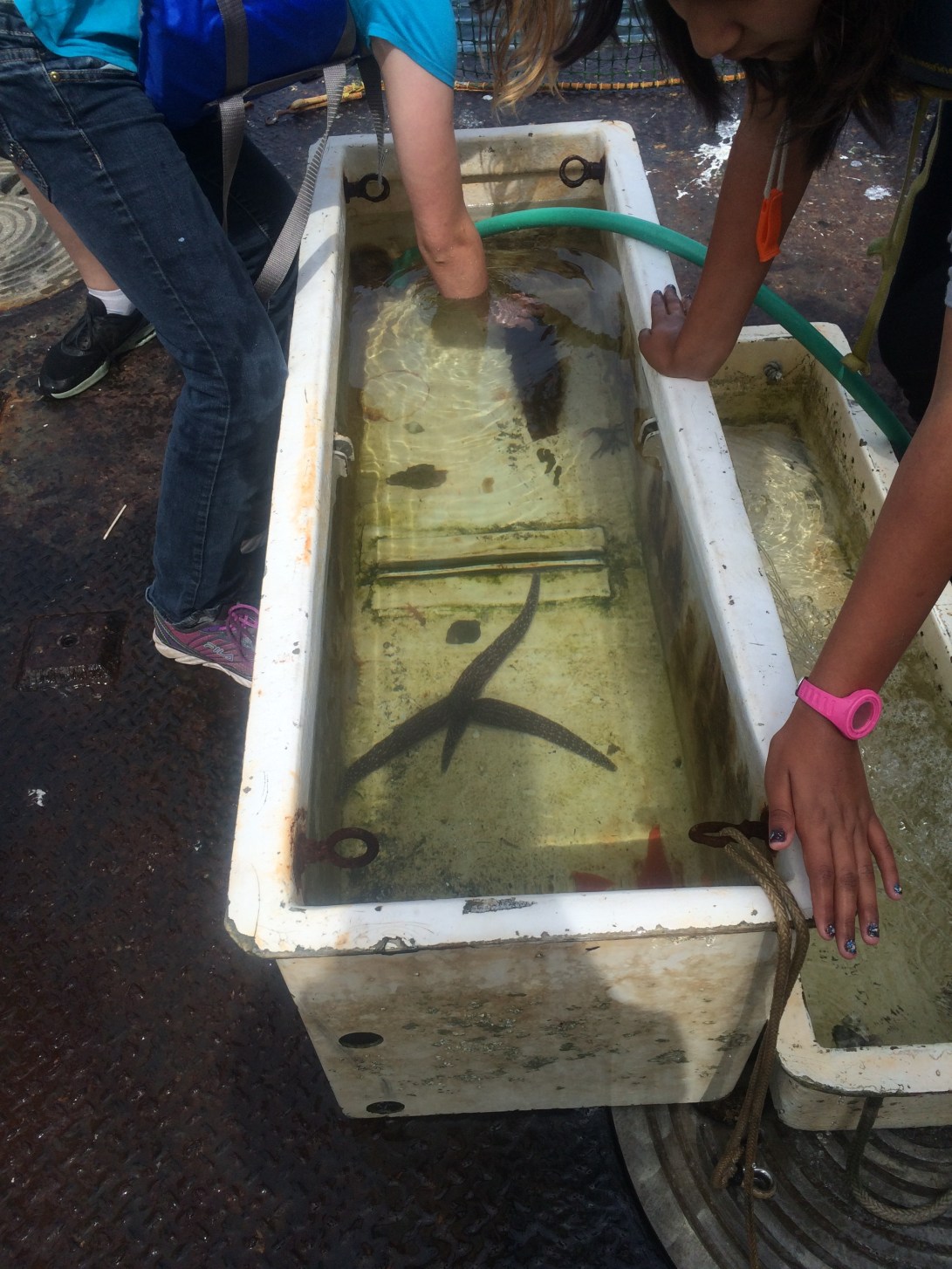
All of these are fairly common Pacific Northwest species, and I even found these all the way up into Southeast Alaska!
The students gleefully inspected all of the creatures in the tank, asked many wonderful questions, and then enjoyed the ride back, using the Centennial as their exciting new playground. They reminded me of my own curious students back at CIMI – I mean, who wouldn’t squeal about petting a lumpy little sea cucumber?
That afternoon I took the opportunity to join a graduate student and one of the volunteer divers, Jess, on a scientific dive. We motored out away from San Juan Island through calm, quiet waters. The surrounding islands were dense with spruce, cedar, and many plants I didn’t recognize, being an East-coaster. We reached the site after a few minutes: an undeveloped island with forests of bull whip kelp gently bobbing at the surface. The kelp itself was the object of study – underwater sets of quadrants were laid, dividing the rocky bottom into different sections. The divers were going to survey the growth and proliferation of the bull whip kelp throughout those quadrants, as they had been doing as part of an ongoing study. The boat driver (also a volunteer – Friday Harbor runs on them!) and myself stayed topside, keeping an eye on the streams of bubbles coming to the surface from the divers. After only diving recreationally for the last few months, it was nice to be back in the scientific diving world. When the divers surfaced, we carefully helped them and their heavy gear back onto the boat, chatted about the dive conditions, and headed back to the labs.
Jess at the bow of the dive boat.
Though it was peaceful and relaxing topside, it’s not so much on the flipside. Scientific diving takes much focus and training, the ability to remain calm underwater (even when science and nature don’t want to cooperate), and significant dive experience. Anything can happen underwater, and our time below the surface is unfortunately always limited by the laws of chemistry and physics. Efficiency is key! Despite the stress of underwater tasks, it’s pretty hard to complain when your office is made of saltwater and your officemates are fish and creatures of all shapes and colors.
In addition to exploring the scientific side of the San Juans, I also took the opportunity to explore the island and its flora and fauna…


Clockwise from top left: Island coastline as viewed from the Centennial, rocky coastline with a bull whip kelp forest at low tide, “Hey, I can see Canada from here!” – Victoria Island in the distance.


Clockwise from top left: Foxgloves grow wild all around the PNW – Highly toxic, they are used to make cardiac medications. Wild salmonberries (similar in flavor to tart blackberries) growing wild by the FHL dorms. The trunk of a Pacific Madrone, a beautiful tree with bark that naturally peels away to reveal the bright green growth beneath. Oh look, it’s the coastline again! Let’s pretend I didn’t post that picture twice.
I made my way over to Lime Kiln State Park, on the western side of San Juan Island, hailed as the best park for whale watching in the world. At this point the only whales I had seen in the wild were various species of dolphins and two grey whales, so I was full of high hopes for seeingthe local pods of orcas. Unfortunately, me standing in the rain for three hours made no difference to the orcas, as they never decided to show up (I did get to see a couple Dall’s porpoises though… I’ll take it).
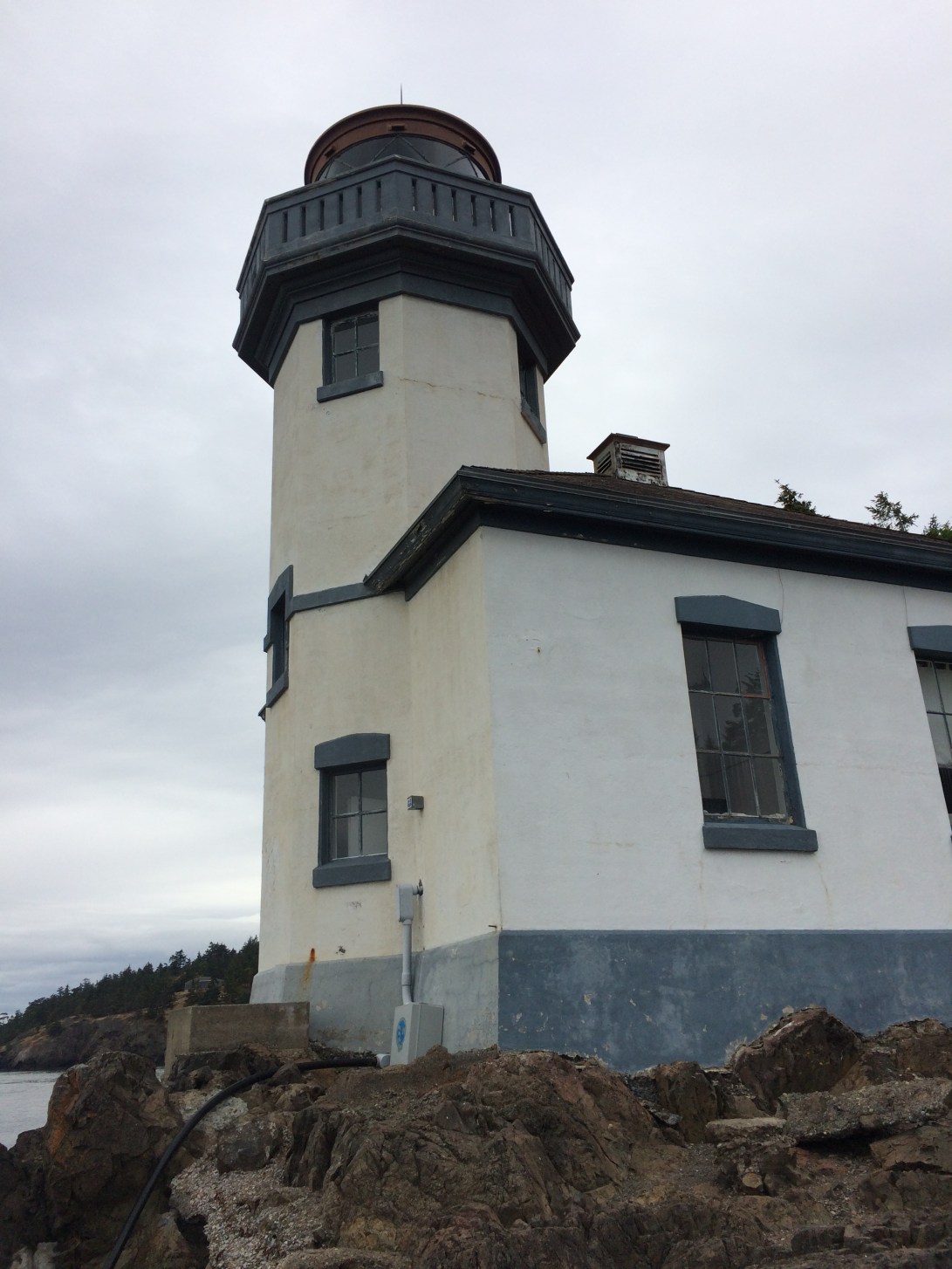
The lighthouse at Lime Kiln State Park.
Luckily for me, I love invertebrates just as much as I love marine mammals! When I finally accepted that the whales probably weren’t going to show, I went exploring and found some gorgeous tide pools! The creatures that are found in and around tidepools are known as intertidal species. This means that as the tides change and the water level rises and falls, these animals are commonly stuck high and dry for a few hours at a time. They’re specially equipped to survive these extreme conditions – some, like the anemones, only live in spots where they will still be in water when the tide recedes, or some even hold onto gravel and sand to shield themselves from the hot sun and wind so that they don’t dry out. Other creatures, such as mussels or barnacles, close up tight, seal in any water, and simply wait for the tide to come back in. All of these intertidal animals survive relatively extreme conditions everyday! Imagine if your house was on a hill above the ocean most of the time, but twice a day the ocean rose and completely covered it for a couple hours. That’s what it’s like to be an intertidal creature!


Clockwise from top left: A massive group of unidentified anemones in a tide pool, close up of some of the anemones in the pool, another unidentified species of anemone, gooseneck barnacles at low tide.
Even though I didn’t see any whales, all in all Friday Harbor was an extraordinary place. Everyone both at FHL and in the town was incredibly kind and welcoming, and FHL was brimming with curious minds, smiling faces, and legions of volunteers who are there simply because they absolutely love what they’re doing. I have a feeling I’ll be making my way back to Friday Harbor… Whether it’s as a student, volunteer, or someone simply on vacation remains to be seen. Until then, these fins will keep on wandering!
 Wandering Fins
Really enjoyed your post! I love the San Juans!
LikeLike